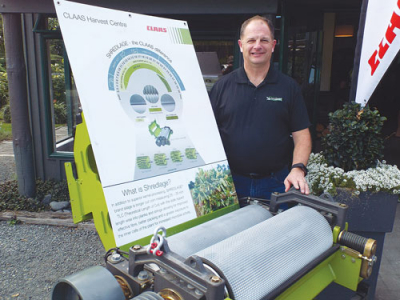
Contractors at a recent meeting held in Waikato by Claas Harvest Centre got insight into a new forage maize technique now gaining momentum in the US and Europe.
Speakers included product specialist Jorg Wesselmann from Claas Germany; Roger Olsen, nutritionist, dairy farmer and inventor of the new Shredlage system; and Adam Clay, ruminant and technical services manager from Nutritech International Limited.
Wesselmann talked about the different markets worldwide for self-propelled harvesters (SPFH), comparing India -- which recently took delivery of its first SPFH -- to Europe where the market is mature and branching in different directions.
In Germany for instance, harvesters work on traditional forage crops for part of the season then move to producing biomass to power anaerobic digesters (AD) which need very short material (down to 4mm chop length).
By contrast, Roger Olson, a native of Wisconsin -- where cows are said to be thicker on the ground than in Waikato -- spoke of the new Shredlage system, which has seen higher feed intakes and subsequent increases in production over a long time.
Wearing his nutritionist hat, Olson saw the development of forage maize feeding from the early days when chop length needed to be about 9mm to smash kernels, and the introduction of kernel processors which allowed chop lengths nearer 20mm; he said he always felt there were benefits to be had from chopping even longer.
He experienced a ‘eureka moment’ when a customer showed him a sample quite different from the norm. He had bought a worn-out chopper with blunt blades and a well-worn shear-bar, and was using brute force, i.e. high power, to force the crop through the machine. Instead of chopping the crop to precise lengths, the sample was largely crushed and the stems were split longitudinally to produce flat thin pieces.
A new processor was designed -- starting with wooden mock-ups and launched in 2010 -- which effectively crushed the kernels and split the stem pieces longitudinally while squeezing them flat, delivering more physically effective fibre at chop lengths of 26-30mm. The system uses two Loren Cut rollers with 145 and 110 teeth respectively, which run at a 50% speed differential.
This raised daily output in the field because of the extended chop length, and more importantly increased the effective fibre in the sample. This was achieved by increasing the surface area of the maize pieces, allowing greater microbial activity in the gut and raising yields by up to 5L/day, and allowing the cow to produce at peak for longer.
From a rationing point of view, Shredlage is said to help save costs by removing the need to add large amounts fibrous material like straw, hay or alfalfa to help digestibility, and focus on the maize which is the lowest cost ingredient.
As with any system, the harvest must be done at the optimum time, which Olson suggests is when a target of 32-34% dry matter is achieved and a milk line is seen halfway up the kernel from its base. Chop length should be about 26-30mm and the processor gap set to about 1.75mm.
Some in the audience expressed concern that longer chop lengths would result in difficulty compacting the stack, but it was suggested that because the crop pieces were soft, flat strings there would be no problem. Tests had shown that consolidation was at least on par with traditional chop lengths where density was typically 18.5 lbs per cubic foot, though if DM increased there might be a need to chop shorter and tighten up the processor gap.
Olson said US farmers’ take-up of the system, now owned by Claas, represented 50% of all custom harvester purchases.
www.claasharvestcentre.co.nz