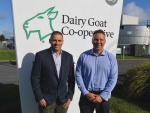
Dairy goat farmers hopeful co-op will turn a corner
Farmer owners of the Dairy Goat Co-operative (DGC) in Hamilton say they believe in the business’s long-term future.




 increase font size
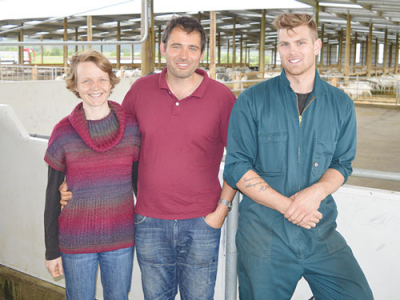 Rene and Verena Burri with farm worker Mitchell Van Dam (right).
There is a definite Swiss connection on Rene and Verena Burri’s dairy goat farm at Te Aroha, Waikato.
Their 700 goats milked twice daily are Saanen, a highly productive Swiss domestic breed.
Rene, from Switzerland and Verena, Germany, in equity partnership with Schuler Brothers Ltd, two years ago bought the property (42ha including leased land), previously part of a cow dairy farm. They named it Swiss Belle after the 700 Swiss beauties they have milked since June 2015.
The farm supplies milk to Dairy Goat Co-op, Hamilton. It employs two full-time staff, Rene and Mitchell Van Dam.
Burri, who grew up on a dairy, beef and pig farm in Switzerland, spent four years in New Zealand on dairy farms; managing a farm for a year then sharemilking for three years at Te Poi.
When the Burris looked at options for farm ownership dairy goats caught their attention.
“We are always open to challenges and goats always keep you challenged,” he told Dairy News. “You need to keep a close eye on the goats; they are highly sensitive.”
Before moving onto Swiss Belle Farm, the Burris’ helped a neighbouring farmer set up a large goat farm.
The goats are kept indoors and fed freshly cut grass, silage and dried distillers grain (DDG) from Oilseed Products NZ.
Milking takes about 1.5 hours. For their milking platform, they opted for a 44-aside Supa4 herringbone from Waikato Milking Systems. A rotary platform was ruled out as too costly. “We wanted to have something simple,” says Burri.
WMS goat milking system specialist Gary Feeney says the Supa4 standard installation process ensures the plant’s integrity.
Its features include a 100mm milk pipe draining into a receiver at one end of the pit; the milk pumping system ensures fast and uninterrupted milking and the simple design makes for fast milking.
The milking plant was installed by Paeroa Farm Services, who also do the annual services.
Farmer owners of the Dairy Goat Co-operative (DGC) in Hamilton say they believe in the business’s long-term future.

A new leadership team and a revamped manufacturing strategy is in place to help Hamilton-based Dairy Goat Co-operative navigate challenges in one of its key export markets, China.
Hamilton-based Dairy Goat Co-operative (DGC) is revamping its leadership in the hope of recovering from its financial doldrums.
There have been leadership changes at the Hamilton-based Dairy Goat Co-operative, which has been struggling financially in recent years.
Dairy sheep and goat farmers are being told to reduce milk supply as processors face a slump in global demand for their products.



Entries opened on Monday, 5 October 2026 for the 2027 New Zealand Dairy Industry Awards (NZDIA), which organisers describe as the nation's biggest celebration of excellence in the dairy sector.
Waikato milk processor Tatua has again declared a record milk payout to farmer shareholders, leaving other processors in the dust.
A Labour-led Government won’t be bringing back the controversial freshwater rules of 2020.
National’s much-touted free trade deal with India featured in the Rural Issues Debate at Mystery Creek, Hamilton on Wednesday night.
New Zealand's 2026-27 freshwater fishing season has opened, with anglers encouraged to head to rivers and lakes over the coming days as conditions look favourable across much of the country.
Central Otago District Council (CODC) has voted against a plan to spread treated sewage sludge from Cromwell and Alexandra on farmland near Lauder, a decision Federated Farmers says reflects strong opposition from rural residents.

OPINION: It seems Canterbury processor Synlait is still in the doldrums.
OPINION: Get offside with New Zealand First leader Winston Peters at your own peril.




