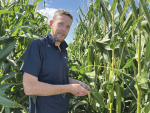
Fall Armyworm in NZ Maize: Four Years of Research
Four years since it was first detected in New Zealand, researchers and growers now know much more about management of maize pest fall armyworm (FAW).




 increase font size
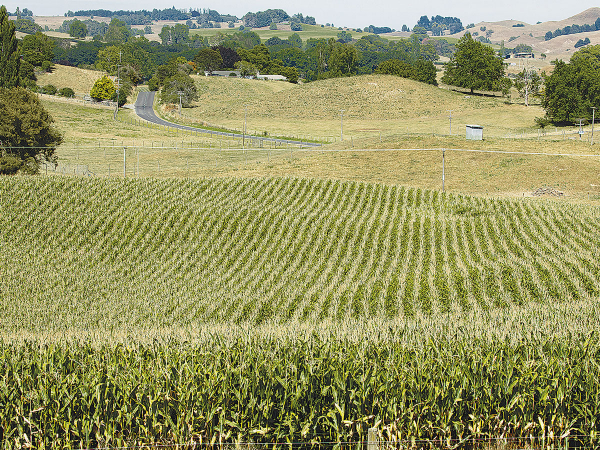 Plant breeders and researchers continually deliver new hybrids that can handle the increasing challenges the environment seems to throw at us.
OPINION: I am a maize tragic. While that may come as a surprise to some, those who have read this column over the last few years will know exactly where I am coming from.
I absolutely love maize. I have been involved with the maize industry and have grown maize on our own account for nearly 25 years. Yet each season I discover something new about maize and I have an even greater admiration for plant breeders and researchers who continually deliver new hybrids that can handle the increase challenges the environment seems to throw at us.
This has been particularly true this season. At home, near Hamilton, we had just 6mm of rain from the 15th of December to the 6th of February when we received 75mm of rain over two days. Before the rain, some areas of our maize were showing severe drought stress, while other places were "just hanging in there". When it was dry, I avoided walking through the crop as it was pretty depressing watching the plants suffer. However, since the rain, I have walked my crop and I am amazed how well it has come through this long period of little rain. I put this down to three things:
Plant genetics
In previous articles I have talked about maize's high water use efficiency (WUE) which is about three times that of ryegrass. This means for every litre of water available, maize produces three times more dry matter than a perennial ryegrass paddock. Maize, a C4 plant like kikuyu or paspalum, is inherently water efficient but drought tolerance has also been a key focus of maize breeders. A few years ago, the team at Pioneer introduced the AQUAmax designation for some of our hybrids. For a hybrid to qualify, it needs to meet certain criteria for performance in water-restricted environments. Over the last few years, we have planted P9911 AQUAmax® at home on our light sandy loam soils. Nearly every year it has more than met our expectatins despite the challenges our growing environment throws at it.
The right management for our growing environment
I am a dairy systems specialist, not a maize agronomist. We grow maize ourselves on dry, sandy soils. When we first started growing maize, we did what our maize growing friends did. We never had a crop failure but some years our profitability wasn't as high as I wanted it to be. It took us some years to realise that our repeat cropping ground on dry soils was not the same as our friend's high fertility ash or peat paddocks with better water holding capacity.
My colleague, Barry McCarter (maize product manager for Pioneer brand seeds), talks about the "Right Product under the Right Management planted in the Right Paddock". With support from Pioneer's agronomy team, we shortened up our hybrids from a longer 113 CRM hybrid to P9911, a 100 CRM hybrid, altered our plant populatin to better reflect the growing environment and reduced our fertiliser input by 200kg urea/ha. Now we produce consistent yields with higher profitability and our system is more environmentally friendly. The take home message is to get the right advice on the right management and the right hybrid for your paddock.
Our contractor
The contractors you use is also important. We have worked with the same contractor for the whole time we have grown maize silage. Each year he goes out of his way to do the best job he can for us. By doing the job well and mostly on time, he helps set us up for success. This year the wet weather meant it was tough to get seed in the ground at the planned time. The contractor's team not only kept us up to date with where they were at, but they worked long hours when the weather was good to try and catch up.
So, if you are thinking about growing maize, I would encourage you to go ahead and do it. And then you will experience for yourself the wonderful plant that is maize.
Ian Williams is a Pioneer maize specialist. Contact him at This email address is being protected from spambots. You need JavaScript enabled to view it..
Four years since it was first detected in New Zealand, researchers and growers now know much more about management of maize pest fall armyworm (FAW).
As spring calving cows head into dry-off, the priority shifts to one thing: setting cows up to calve at the target body condition score (BCS).
Early December marks a key transition for many dairy farmers, as weaned replacement heifers head off-farm to grazing.
I recently had the pleasure of attending an AgFirst event in Hamilton where the results of the 2024-25 Waikato-Bay of Plenty Dairy Financial Survey were shared. Based on a 136ha farm milking 379 cows, average farm profit before tax was $405,892, an incredible 286% increase on the 23-24 season.
Over the past few months, I’ve had the privilege of speaking with many farmers at events and one-on-one.



LIC shareholders have elected a new North Island representative to the co-operative's Board, along with five representatives to its Shareholder Reference Group (SRG), following the company's Annual Meeting held in Invercargill.
Farmers across parts of Southland and South Otago are continuing to deal with difficult conditions after a prolonged run of wet weather, with pressure building around feed supply, stock management, pasture damage, farm infrastructure and everyday workloads.
Federated Farmers says it welcomes Labour's commitment to reviewing the Sharemilking Agreements Act, calling on other major parties to do the same.
For Canterbury dairy farmers Sian Meijer and Rick Wobben, wearable technology has become one of their most valuable on-farm tools - helping manage 1850 cows across an expansive, high-performing dairy operation while improving efficiency, mating outcomes and day-to-day decision making.
Fonterra has unveiled its annual results for the 2026 financial year, posting $27 billion in revenue and close to $20 billion returned to New Zealand farmer owners and unit holders.
The first major update to the Dairy Cattle Code of Welfare in more than a decade has been released, marking what DairyNZ describes as an important step in ensuring animal welfare standards continue to evolve alongside scientific evidence and on-farm realities.




OPINION: It seems Canterbury processor Synlait is still in the doldrums.
OPINION: Get offside with New Zealand First leader Winston Peters at your own peril.




