Dairy
Global commodity prices have enjoyed a period of strength in September. Overall, the global market fundamentals remain well-balanced, but with several moving parts.
A slowdown in milk production in key production regions, combined with buoyant import purchasing from Asian buyers, has seen commodity prices lift through August and into September. A slow start to milk production in Oceania could help provide further price support in the near-term.
Northern Hemisphere milk production is losing steam. In the United States, milk production expanded by 1.1% in August, which was below the recent trendline. In Europe, milk production has hit a snag in some key producing member states. EU-27 milk production was down 0.6% in July, driven by large milk producing engines Germany and France.
Looking closer to home, New Zealand's milk production growt has stalled in the lead up to the spring flush. August milk production was down 4.8% (on a tonnage basis) compare to August 2020. There is still time for production to turnaround this season, with October a pivotal month for total volumes.
RaboResearch maintains milk price forecast of NZ$ 7.80/kgMS.
Beef
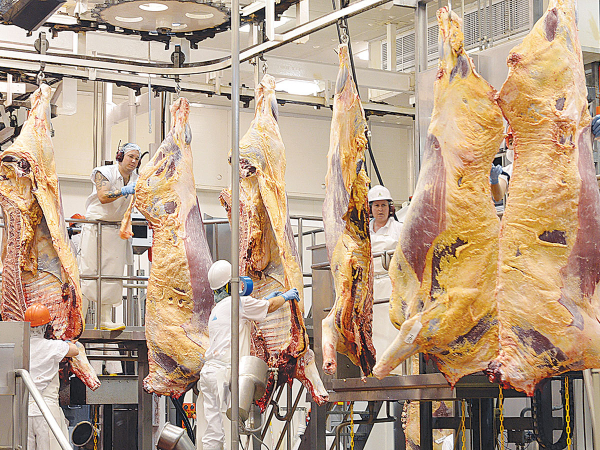
One gap in global beef supply will narrow in October. The Argentine government has announced that export restrictions will be lifted - a month earlier planned. Argentine beef exports have been restricted to 50% of 2020 volumes since May this year, in a bid to reduce domestic inflation.
This resumption of exports is good news for China, which relies on Argentina as its second largest supplier of beef after Brazil. Despite an increase in Argentine beef in the market, it is anticipated that shortages will still exist due to the suspension of Brazilian beef exports and reduced Australian exports.
The ongoing disruptions to global beef supply is driving New Zealand farmgate beef pricing positive with strong demand from key markets.
Rabobank anticipates farmgate beef pricing to remain elevated through to November due to the global beef shortage and sustained demand for 95CL bull beef from the US. However, New Zealand farmers' ability to capitalise on the strong pricing is uncertain.
We suspect that paddock inventory is low due to drought earlier this year and the high numbers already killed this season.
Steer and heifer kill are 16.8% and 14.6% ahead respectively for the season to August 31, compared to the 2019/20 season.
Sheepmeat
Record lamb prices continue to climb, with farmgate prices lifting NZ$ 0.20/kg cwt across both the North and South Island over September.
A reduced lamb crop in spring 2020(300,000 head fewer), in culmination with increased demand from the US, has resulted in procurement pressure late in the season. Lamb exports to the US are up 32% for the 11 months to August 31, 2021, compared to the 2019/20 season.
The US is New Zealand's fourth largest export destination for lamb and continues to grow - 2021 season-to-date exports to the US are 17% above the four-year average.
Increased consumer awareness of lamb presents a positive demand outlook, particularly given the increase in products being purchased in supermarkets and cooked at home rather than in restaurants.
Covid-19 has highlighted the importance of a diversified market channel and retail-ready products.
New season lamb will likely take heat out of the market; however, we anticipate pricing will remain elevated. We expect farmgate price support to be maintained through to the end of the 2021 based on the demand from key markets and the continued recovery of food retail in Europe after Covid.
Exchange rate
After recovering from August's sharp dip to nine-month lows, the NZ$ spent much of September working its way back down again to end the month below USc70.
With multiple rate rises on the cards and still good economic data, we forecast the NZ$ to strengthen on a 12-month view, but to stay near to current values for the rest of the 2021.
Q2 NZ GDP figures released this past month showed a quarterly surge of 2.8% - more than double market expectations and four times the RBNZ's own forecast.
This was alongside a drop in the unemployment rate to 4%, an uptick in wage inflation and booming manufacturing PMI data. Unsurprisingly, this was also accompanied by a spike in the CPI inflation rate to 3.3%, and well above the RBNZ's target range. Despite a likely Covid lockdown drag on GDP in Q3, the RBNZ is still expected to take steps up in the rate to target this inflation, and markets are pricing in a total of 50 bps on a three-month view, and a total of 80 bps on a six-month view.
Rabobank forecasts the NZ$/US$ willl trade near to 0.69 on a three-month view, and towards 0.72 and 0.74 on a nine-month and 12-month view respectively.