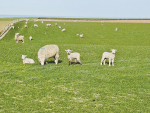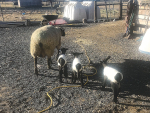
Woollen covers that keep newborn lambs safe, warm
A Christchurch manufacturer of woollen covers for newborn lambs says his covers pay dividends in survival rates and liveweight gains, especially at a time when farmers are feeling the economic pinch.




 increase font size

FAST GROWING, easily delivered lambs with great survivability and conformation: that’s what you can expect when you use a Southdown ram, says breed society president Blair Robertson.
“We’re focussed on maintaining that [early] mean kill date for our clients and continuing to keep the meat content up.”
Eye muscle area scores have been steadily increasing over recent years and fat content, once a point to watch with the breed, has come down to the point where breeders are now careful they’re not taking it too low with their selections, he adds.
“If we take it too low we might start to lose some of that early maturity.”
Breeders are also taking care not to take them too big, too leggy, as can happen if selection for growth isn’t handled carefully. They’re really grunty, nuggetty, lambs,” he stresses.
That’s already showing in lambs born this spring to 1200 ewes he’s conducting a trial with to compare performance of the breed with five other terminal sire breeds.
The ewes were all in-lamb when he bought them, so other than the breed they’d been mated to, sire selection was out of his hands. Growth rates, and kill dates and weights will be monitored, with carcase yield data too if possible.
“We’ll either do all the twins, or all the singles.”
Another initiative the society is considering is a spring/early summer retail or restaurant promotion based on the breed’s earliness and quality of meat. To that end last year a restaurant survey found all but one of 23 diners were 100% satisfied with the meat in their meal, and the exception was due to excess gravy.
“It was so successful we’re going to do it again this season. What we’re thinking is rather than promoting Southdown lamb as a year-round product it should have a season, a bit like the oyster season, so people look forward to getting those early lambs.”
Robertson notes Beef + Lamb New Zealand’s Golden Lamb Awards, aka The Glammies, held at Wanaka A&P Show in March, while a laudable initiative for rewarding farmers producing high yielding, high quality meat, isn’t the ideal timing for the Southdown.
“Our focus is early maturity. A lot of the good Southdown lambs are long dead by then. We’re taking the first draft at 10-11 weeks off their mums. We had a line of Romney x Southdown lambs out of hoggets that did 16.8kg in the first draft last year. They’re the ideal ram in my opinion.”
The meat off the “tight-wool” lambs is particularly fine, he notes. “You could cut it with the back of your fork it’s so tender. It’s the only thing we kill for the house.”
While schedules typically reward those who get lambs away early with the best prices, if producers want to grow the lambs out to heavier weights they can, he adds. “I’ve got ram clients who are killing Southdowns at 22kg. You can grow them out if you want to. They’re not like the old Southdowns that would go overfat.”
The move to yield payments should also suit the breed, he believes.
The number of breeders has been creeping up in recent years, with just over 80 in the Southdown Breed Society now. Most rams are sold before the traditional sale season starts with a few held back for the main North (ie Feilding Ram Fair, December) and South Island auctions.
“There are three breeders holding on-farm sales too now.”
A Christchurch manufacturer of woollen covers for newborn lambs says his covers pay dividends in survival rates and liveweight gains, especially at a time when farmers are feeling the economic pinch.
Early weaning of lambs can be a valuable management tool that can advantage both ewes and lambs.
Drought in the North Island had a significant impact on the number of lambs tailed in the first half of this season.
Maintaining ewes in good body condition and the provision of shelter are two important management factors in maximising this year’s lamb crop.



The Royal New Zealand College of General Practitioners (the College) and Hauora Taiwhenua Rural Health Network are calling for investment in a proposed new training pathway for rural GPs, warning that many rural practices are struggling to recruit while a large share of the existing workforce nears retirement.
Federated Farmers has called on Central Otago District Council (CODC) to drop or vote down a plan to truck sludge from Alexandra and Cromwell to farmland near Lauder, warning it would compound an "outrageous" situation created by a separate council's decision weeks earlier.
Synlait has swung to second-half profit as operations stabilise, but the dairy processor still posted a $75.4m annual loss.
LIC shareholders have elected a new North Island representative to the co-operative's Board, along with five representatives to its Shareholder Reference Group (SRG), following the company's Annual Meeting held in Invercargill.
Farmers across parts of Southland and South Otago are continuing to deal with difficult conditions after a prolonged run of wet weather, with pressure building around feed supply, stock management, pasture damage, farm infrastructure and everyday workloads.
Federated Farmers says it welcomes Labour's commitment to reviewing the Sharemilking Agreements Act, calling on other major parties to do the same.





OPINION: The same mainstream media muppets that brought you Jacindamania in 2017 have been flat out pimping for the Opportunities…
OPINION: Your old mate reckons the atrocious way farmers in the UK are treated by their lords and masters in…