BCS Targets: Why Body Condition Score Matters at Calving
Body Condition Score (BCS) is a critical element in managing the health and reproduction of the dairy herd.




 increase font size
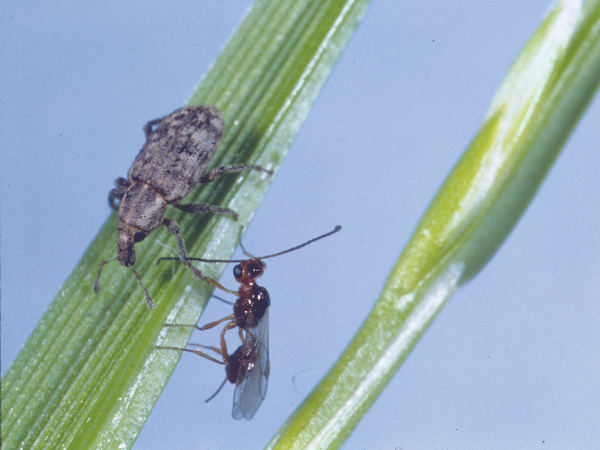 The Argentine Stem Weevil and the parasitoid wasp imported from South America to manage it.
In the late 1980s, planes flying from South America to New Zealand carried some unusual and precious travellers, tucked away in the business- class drinks cabinet, of all places.
These tiny passengers were wasp eggs and larvae sitting inside weevils, which upon arrival in New Zealand would become soldiers in a war against entrenched agricultural pests that has saved the country hundreds of millions of dollars.
The importation of these South American ‘parasitoid wasps’ was under the direction of pioneering AgResearch scientist Stephen Goldson and colleagues.
Looking back, the now-emeritus scientist says the unusual method of transporting the wasps was just one bizarre component of an unlikely scientific success story.
“We couldn’t send the wasps themselves because they’re far too delicate and don’t live very long,” Goldson explains.
“So, we sent over thousands of these weevils infected with wasp eggs. We put them into boxes, and we put ‘important’ labels all over each of them, saying ‘don’t open this box’. I mean, they could have been full of cocaine, but it was a gentler age then, right? The problem was that we couldn’t put them in the aircraft hold because we were flying over the Antarctic, and they’d freeze. So, Aerolíneas Argentinas was employing a flight attendant who was a friend of our group, and she undertook to bring this stuff over in the drinks’ cabinet, which was at a nice eight degrees Celsius. We introduced thousands of wasps into New Zealand like that.”
Upon arrival, the infected weevils went into quarantine, then into cages where researchers waited for the wasp pupae to “drop out” of the weevils and become early generations of the parasitoid wasp released in New Zealand.
“Up to that time, I had never seen the wasp. I had only seen the larvae. It was a bit like seeing your first-born — it was very exciting. We spent the thick end of a million dollars showing that the wasp was pretty reliably attacking the Argentine stem weevil, and not attacking much in the way of ‘non-target’ weevils.”
Goldson and fellow researchers were working on an educated hunch that the introduced wasps would be effective in New Zealand’s pasture environment.
The pest weevil had earlier been (accidentally) introduced and as a consequence, was thriving without natural enemies. The wasp works by laying eggs in the weevil, making it unable to reproduce and killing the weevil as the egg hatches and wasp larvae emerges.
“Catching these things in South America wasn’t easy. And some of these places weren’t particularly stable, politically. I turned up in Buenos Aires and Sao Paulo with a butterfly net and a practically useless phrasebook, and I had no idea where to go. I was being pulled in by various levels of authority asking what the hell was I doing.”
To determine which weevil populations had the wasp eggs in them, Goldson set up makeshift stations on “rickety tables” with a microscope and lights in his hotel rooms, to perform weevil dissections.
“Owners of the hotels were dubious and usually thought that I was doing something illegal; drugs or something.”
Goldson says the enormous success of imported wasps in controlling populations of Argentine, lucerne and clover root weevils in New Zealand was a “1000 to one chance”.
Body Condition Score (BCS) is a critical element in managing the health and reproduction of the dairy herd.
Bull management involves ensuring the right number of healthy bulls for your herd, minimising stress and reducing injury risks.
It's easy to look over a lush spring paddock and assume cows are getting enough usable nutrition. But while fast-growing pasture can give plenty of volume, in high moisture, variable dry matter and uneven mineral profile can leave real nutrition gaps when cows need it most.
Rearing facilities should be set up and maintained well to ensure calves stay healthy.
Solid biosecurity practices, regular monitoring and timely vaccination are the three key pillars of effective Bovine Viral Diarrhoea (BVD) control on New Zealand farms. Zoetis veterinary technical advisor, Karley DeFrees, explains BVD is a costly but preventative disease that impacts a significant number of dairy farms in New Zealand. Implementation of a BVD control plan can help protect your herd from this avoidable disease.


Celebrating 50 years in the rural landscape of Central Canterbury and beyond, Ashburton-based Carrfields, has been the exemplar for all aspects of modern agriculture via its extensive range of services including supply, growing, agronomic advice and marketing.

For Taupiri dairy farmers Logan and Sian Dawson, their involvement in the NZ Dairy Industry Awards has been a key catalyst in the growth of their business - the experience helping shape how they approach the farm ownership pathway they are pursuing today.
West Otago dairy farmer Luke Kane has been awarded the 2026 Rabobank Dr John Morris Business Development Prize.
OPINION: As the general election approaches, political parties are churning out policies in the hope of attracting more votes.
An LIC bull, Tronnoco AR Sadio-ET S3F, bred by Tony and Keri O'Connor of Tronnoco Farming Co Ltd near Timaru, has won the 2026 Mahoe Trophy.
With forecasters advising El Niño conditions will develop through winter and strengthen into spring and summer, Ballance Agri-Nutrients is encouraging farmers and growers to think ahead about nutrient planning and be prepared to work around challenging weather conditions.





OPINION: The same mainstream media muppets that brought you Jacindamania in 2017 have been flat out pimping for the Opportunities…
OPINION: Your old mate reckons the atrocious way farmers in the UK are treated by their lords and masters in…