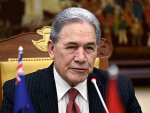
Winston Peters' FTA attacks 'just dog whistling' - Jacobi
International trade expert Stephen Jacobi says Winston Peters' objections to the Indian free trade deal are "ridiculous".




 increase font size
 NZ International Business Forum (NZIBF) executive director Stephen Jacobi.
New Zealand’s free trade agreement (FTA) with the European Union comes into force on May 1, offering differing benefits for different sectors.
The earlier than expected entry into force means tariff savings of $43 million for kiwifruit exporters, and $3 million for onion exporters this season. The FTA will bring tariff savings of $100m per year on New Zealand exports to the EU from day one.
NZ International Business Forum (NZIBF) executive director Stephen Jacobi notes that achieving the agreement was difficult.
“It offers differing benefits for different sectors”, says Jacobi.
“The FTA will open the European market to several key export industries especially horticulture, seafood, wine, honey, manufacturing and some services.
“For those sectors provided with immediate tariff relief, the agreement will be very useful. The earlier than expected entry into force is a bonus for those horticultural sectors especially kiwifruit and apples, whose season’s shipments are about to arrive in Europe.
“Other sectors, such as dairy and meat, will be looking at whether there are potential commercial opportunities as a result of the limited amount of additional access”.
Jacobi says it was hoped the FTA’s market access outcomes for dairy and beef could be improved over time.
Beyond exports, the FTA should lead to increased EU investment into New Zealand.
“The separate agreement to extend the application of the EU Horizon Fund to New Zealand should also increase scientific co-operation and EU investment and collaboration in research and development. This is all very positive for the economy at a difficult time.”
However, Jacobi says concerns remain about the implementation regime for geographical indications (GIs) for cheese and wine.
“GIs is an area where New Zealand has had to change current practices. The enforcement regime as proposed seems to go further than necessary in meeting the requirements of the FTA. We hope this can be addressed as arrangements are implemented”.
“We congratulate those who have worked hard to bring the FTA into force. Our attention will now turn to making this agreement work”, says Jacobi.
Trade and Agriculture Minister Todd McClay says all parties involved in the committee process agreed to complete the legislative process by the end of March. This will mean the agreement can enter into force on the first day of the second month, 1 May, instead of July or August, which would have excluded much of this year’s Kiwifruit and Onion exports.
The EU has completed its ratification processes, and the agreement has been signed off by the European Parliament and council.
NZ MPs voted overwhelming in favour of legislation in Parliament on Thursday afternoon, with only the Maori Party opposed, allowing the deal to take effect in just over a month's time.
“The FTA will level the playing field for Kiwi businesses, increase the resilience of our economy, and contribute to the Government’s target of doubling our export value in 10 years,” says McClay.
“Once in force, over 70% of New Zealand’s exports will be covered by our FTA network. Meaning free and fairer market access for New Zealand exporters.”
International trade expert Stephen Jacobi says Winston Peters' objections to the Indian free trade deal are "ridiculous".

Leading trade analyst Stephen Jacobi has rubbished claims that New Zealand could have got a better free trade deal with India if it had prolonged the negotiations.
New Zealand’s top business leaders are urging the US Administration to review “unjustified and discriminatory tariffs” imposed on Kiwi exporters.
The recent squabble between the Cook Islands and NZ over their deal with China has added a new element of tension in the relationship between China and NZ.
The world is now amid potentially one of the most disruptive periods in world trade for a very long time.


New Zealand's citrus growers were challenged to build their future on the value embedded in their fruit rather than the volume they produce, at Citrus New Zealand's annual gathering in Gisborne on 17 September.

Leading John Deere technicians and apprentices from New Zealand and Australians were recognised at the recent sixth annual JD Technician of the Year Awards, held in Brisbane.
In Dacre, near Invercargill in New Zealand’s South Island, Bruce Dinnington is running a dairy operation unlike any other.
A free online platform aggregating governance vacancies across rural and regional New Zealand has been launched.
Environment Minister Nicola Grigg has announced details of a new rural plastics recycling scheme.
Agricultural drone operators say that a government decision to allow lower-risk drone work without certification won’t lower standards but drive innovation and efficiency.





OPINION: The same mainstream media muppets that brought you Jacindamania in 2017 have been flat out pimping for the Opportunities…
OPINION: Your old mate reckons the atrocious way farmers in the UK are treated by their lords and masters in…




