Last year (2016) was one of growth for horticulture.
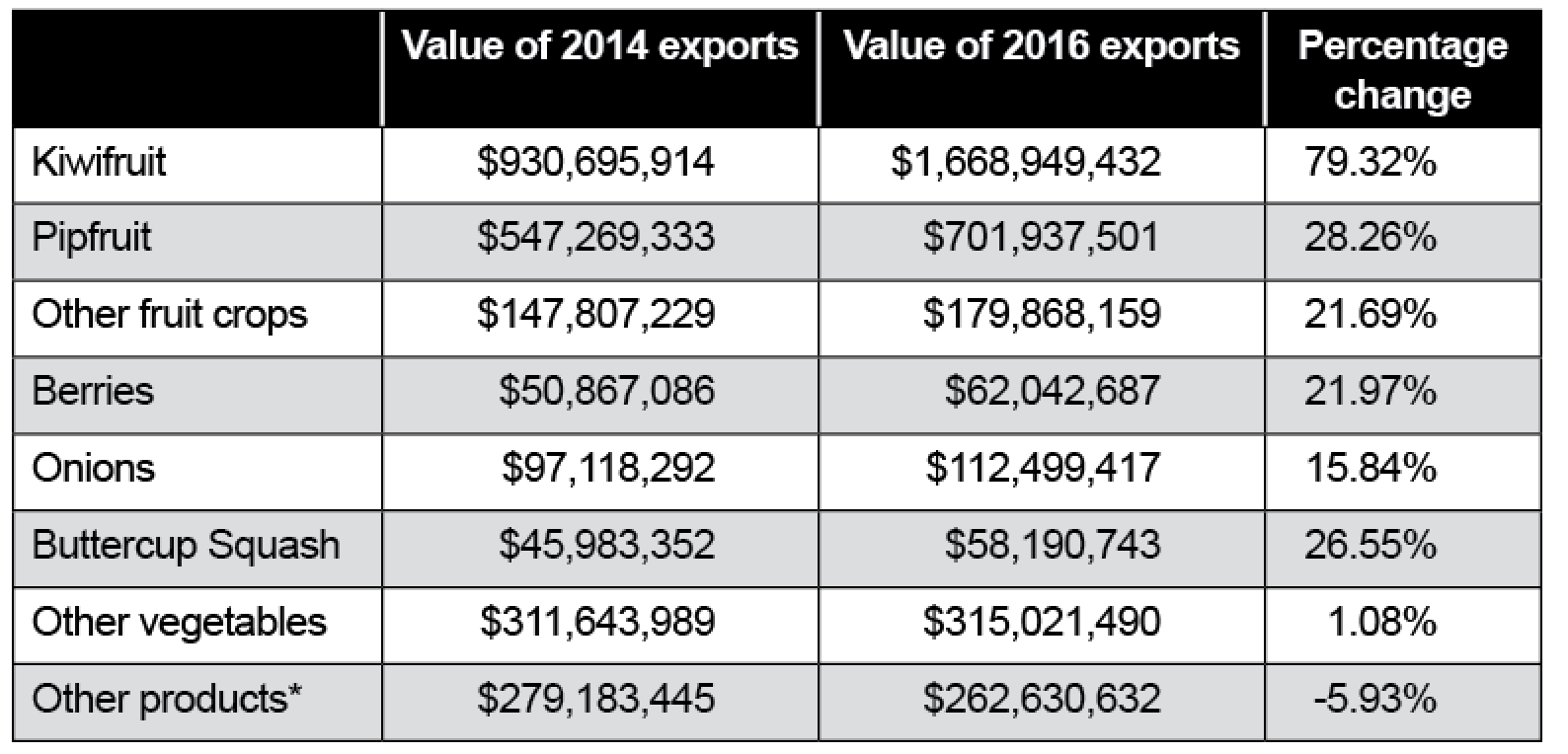
For the year ending June 30, 2016 export growth was as (see table below*).
The challenge now is to consolidate and continue that growth in 2017. The key contributors to that happening include market access; protection of vegetable/fruit growing land from urbanisation and lifestyle blocks (only 5% of New Zealand is suitable for horticulture); access to water; access to reliable and skilled labour; ready registration of new compounds, biopesticides and biological control agents; grower succession; management of the biosecurity risks posed by Queensland fruit fly and the brown marmorated stink bug; manageable regulatory compliance; and managing the impacts of climate change. These matters challenge most primary industries. As an industry we are advocating to mitigate the risks to continued growth.
Three related issues stand out: market access, protecting our crops from pests, and biosecurity invasions.
The minimum residue levels for pest protection compounds are progressively reducing in our export markets, mainly in response to consumer awareness and demands. Added to this, the chemical companies are reluctant to bring ‘new age’ compounds onto the NZ market. This is due to regulatory complexities in gaining approval for use in NZ and the small size of this market presenting limited financial returns.
Introducing chemical alternatives such as biopesticides and biological control agents into New Zealand is difficult. There are no established processes for biopesticides, and obtaining biological control agent approval is a rigorous and lengthy process. Unless horticulture is able to embrace new technologies, our ability to get our products into overseas markets will become progressively limited. This is a major challenge to our growth.
The brown marmorated stink bug is a prime example of a pest we should be getting prepared for. It will eat most vegetables and the leaves of fruit trees in home gardens, as well as many commercially grown fruit and vegetables. Once it’s finished eating its way through our gardens and crops, it likes to spend the winter in dark spaces; the eaves and walls of houses are among its favourite spots, and once disturbed it will give off a horrid smell, hence the name.
 See the picture, the poster and watch this video to see how it affects people and their homes. This pest is not confined to damaging crops, it will invade your home too. If you see what you think is a brown marmorated stink bug, catch it, take a picture of it, and report it on 0800 80 99 66.
There are no viable chemical controls for the brown marmorated stink bug, but there is a natural predator. We have started the approval process for this biocontrol agent to be introduced into NZ, should it be needed.
We are fortunate that the Ministry for Primary Industries and Plant and Food researchers have strong links to US scientists who have experience managing this stink bug. At present it is sweeping across Europe and US. Production and horticulture’s growth will be significantly affected should it get established in New Zealand. Keeping it out through strong biosecurity policies and actions is our best option.
For horticulture to continue to grow, supporting local economies as well as NZ’s total economic health as a country, we need an active partnership with the Government and its agencies to manage risks and capitalise on opportunities; these are goals for 2017.
• Mike Chapman is the chief executive of Horticulture New Zealand
*Other products: Citrus juice and other citrus products, kumara, processed and mixed veges not included above, fruit mixes and dried fruit which couldn’t be separated by commodity type, and export nuts & nut mixes. Source: Report on New Zealand Horticulture Barriers to Our Export Trade 2016.