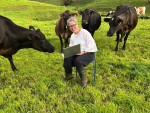
International Day of Rural Women: Two DairyNZ Farmers’ Stories
Today, 15 October, is the International Day of Rural Women, which recognises rural women’s contribution to farming, communities and the environment.




 increase font size
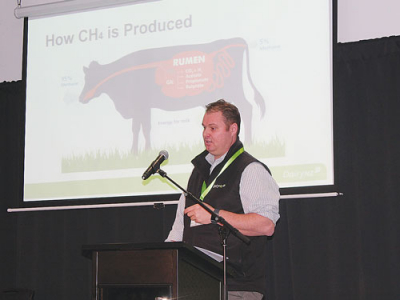 Nick Tait, DairyNZ.
New Zealand has the highest agricultural emissions of the 170 countries that have ratified the Paris agreement, says DairyNZ’s Nick Tait.
This is why many countries are watching to see what NZ will do over the next 10-20 years, he says.
The dairy industry contributes 22.9%, or just under a quarter, of NZ’s emissions. About 49.2% of all emissions come from agriculture, of which dairy is about 46.5%.
“For a developed country we have a unique profile. The closest one to us is Ireland where about 30% of emissions come from agriculture,” Tait told the NZ Institute of Primary Industry Management conference in Hamilton last week.
A lot of work is occurring together, he says. The NZ Greenhouse Gas Agricultural Gas Research Centre and the Pastoral Greenhouse Gas Research Consortium are research streams closely linked.
Within the last two years BERG (Biological Emission Research Group) has been set up ‘’to quantify what we can do to reduce emissions and what that is going to cost us’’. Reports from that are imminent.
“There are lot of work streams all trying to work together and that includes being part of the Global Research Alliance,” Tait says.
“After the Paris agreement was signed we were asked as an industry ‘what are you doing to help the farmers to reduce emissions?’
‘’As of June last year we launched the Dairy Action Climate Change. That was an industry/government agreement with Fonterra as a partner and supported by the Ministry for Primary Industries and the Ministry for the Environment. That tried to set the steps for building a platform to look at what we can do in the context of a profitable and sustainable dairy industry.
“This is due to finish in November this year.”
First came building a foundation, including workshops for rural professionals in September last year, for farmers in June this year and other roadshows for farmers and dairy environment leaders.
Secondly they set up a couple of training courses with AgResearch and Massey University to try to seed the market to train rural professionals.
And they went to dairy environment leaders’ groups and asked ‘who would like to become climate change ambassadors?’ “[These represented] farmers who can speak for the industry so it doesn’t look like it is coming from us all the time.
‘’Another component due to start shortly is ‘Steps to a Lower Emissions Dairy Sector’. This is real cases with real partner farms where we can track a journey and see what emissions reduction and nitrogen leaching reduction would actually look like.
‘’We want to quantify the effect on production and profitability and the feasibility of some of these mitigations options.
“It is all very good to model a reduction, but actually to quantify that onfarm is where we want to go.”
The last component is the onfarm recording Fonterra has implemented to set up -- similar to the nitrogen programme -- a report pathway to 100 farms as a pilot to look at what their actual emissions would be and what information they would want on those emissions.
‘’They looked at that in Overseer and as part of a life cycle analysis and a national inventory. They will provide information back to farmers on what their footprint would actually look like.’’
Today, 15 October, is the International Day of Rural Women, which recognises rural women’s contribution to farming, communities and the environment.
The first major update to the Dairy Cattle Code of Welfare in more than a decade has been released, marking what DairyNZ describes as an important step in ensuring animal welfare standards continue to evolve alongside scientific evidence and on-farm realities.
Have a plan in place for your cows and staff.
DairyNZ deputy chair Cameron Henderson has been re-appointed unopposed for another term.
OPINION: The stats speak for themselves.



Federated Farmers has welcomed new rural policies released by ACT, saying they align closely with its own election priorities.

Rural Contractors NZ says proposed changes to land transport rules for agricultural vehicles are a welcome response by the Government to out of date regulations which have seen members hit with huge fines.
Alliance is calling for final applications for its 2027 Graduate Programme, with applications closing on Sunday 25 October.
Decades piloting planes has ensured vet and farmer David Hayes is focused on safety. So, after a serious accident while welding on farm, he is sharing his experience so others can learn from it.
Canterbury milk processor, Synlait Milk has confirmed Leon Fung as its chief executive officer.
OPINION: Making it easier to collect rainwater and use it to grow crops and livestock is a no brainer.

OPINION: It seems Canterbury processor Synlait is still in the doldrums.
OPINION: Get offside with New Zealand First leader Winston Peters at your own peril.




