Milk Powder Prices Prop Up Farmgate Milk Price
Milk powder prices are keeping farmgate prices up, helping processors offset the dip in milk fat prices.




 increase font size
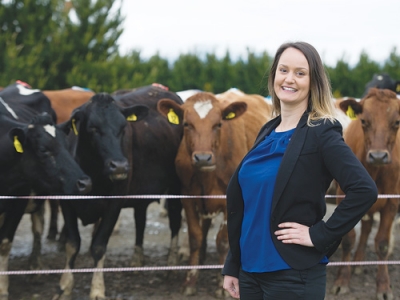 Emma Higgins, Rabobank.
News out of Europe was more interesting than the lacklustre Global Dairy Trade auction last week, says Rabobank dairy analyst Emma Higgins.
Signs of a slowdown in milk production in Europe are strengthening.
"EU's milk worm continues to turn with official Eurostat data indicating EU-28 milk production increased just 0.8% year-on-year in May 2016, down from a 1.7% growth in April 2016," Higgins told Dairy News.
"Interim data shows German and French production was down 3.3% and 3.5% in the last week of June respectively. These are the two largest milk producing states.
"Culling is also on the increase. May 2016 cow slaughtering data show increased culling among the major EU milk producing states. In the three months to May 2016, German cow slaughtering was up 14% versus the same period last year, and UK slaughtering was also up by 18% during the period.
"Cow culling is up in France and Ireland as well, by 7% and 4% respectively."
Fonterra says in its July Global Update that the April EU production increase of 1% vs the same month last year was the lowest rate of increase since early 2015. Half of the top eight producers decreased production vs the same month the previous year.
The overall price index remained unchanged at last week's Global Dairy Trade auction. The whole milk powder (WMP) index up was up 1.9% to an average US$2079/MT. Butter prices dipped 5%, while skim milk powder and cheddar also fell circa 1%. In contrast, anhydrous milk fat and casein prices were up slightly.
ASB's Nathan Penny says dairy markets have largely shrugged off effects of Brexit and the focus is now on the big picture – supply and demand.
"On that front we will be looking to see what happens with European supply, New Zealand supply and the others and see how that plays out and how it translates into prices from here."
Some longer term contacts for WMP showed a little promise, up by 3-4%.
"It's not much at this stage but it's a hint that buyers are thinking prices are going to lift at some stage," says Penny.
ASB is maintaining its $6/kgMS forecast. "We are continuing to look at that supply picture – for example while it's early days, Fonterra's June collections were down 10% on last year. We will see how that plays out but we think we might get a fall of up to 5% this season. If we start to get something like that as we get into the spring, prices will move quickly."
GDT results
AMF index up 0.2%, average price US$3,628/MT
Butter index down 5.0%, average price US$2,687/MT
BMP index down 0.5%, average price US$1,565/MT
Ched index down 1.1%, average price US$2,886/MT
LAC index down 4.0%, average price US$721/MT
RenCas index up 0.4%, average price US$5,286/MT
SMP index down 1.1%, average price US$1,927/MT
WMP index up 1.9%, average price US$2,079/MT
Milk powder prices are keeping farmgate prices up, helping processors offset the dip in milk fat prices.

Chinese beef trade quotas and a looming suspension of Brazilian beef imports into the European Union are expected to reshape global beef trade flows over the remainder of 2026, with implications for New Zealand exporters, according to Rabobank's Q3 Global Beef Quarterly report.
New Zealand consumers are paying more for beef mince than ever before, with the average retail price now sitting above $24 per kilogram, according to Rabobank.
West Otago dairy farmer Luke Kane has been awarded the 2026 Rabobank Dr John Morris Business Development Prize.
Twenty five secondary school students from around New Zealand recently completed a three day residential programme designed to explore career opportunities across the food and fibre production supply chain.

New Zealand's citrus growers were challenged to build their future on the value embedded in their fruit rather than the volume they produce, at Citrus New Zealand's annual gathering in Gisborne on 17 September.
Leading John Deere technicians and apprentices from New Zealand and Australians were recognised at the recent sixth annual JD Technician of the Year Awards, held in Brisbane.
In Dacre, near Invercargill in New Zealand’s South Island, Bruce Dinnington is running a dairy operation unlike any other.
A free online platform aggregating governance vacancies across rural and regional New Zealand has been launched.
Environment Minister Nicola Grigg has announced details of a new rural plastics recycling scheme.
Agricultural drone operators say that a government decision to allow lower-risk drone work without certification won’t lower standards but drive innovation and efficiency.



OPINION: It seems Canterbury processor Synlait is still in the doldrums.
OPINION: Get offside with New Zealand First leader Winston Peters at your own peril.




