
Makita Launches GP001G 40VMax XGT Cordless Grease Gun
Power tool manufacturer Makita has released details of its new cordless GP001G 40vMax XGT grease gun, designed as a practical and precise solution for lubrication of the largest machinery.




 increase font size
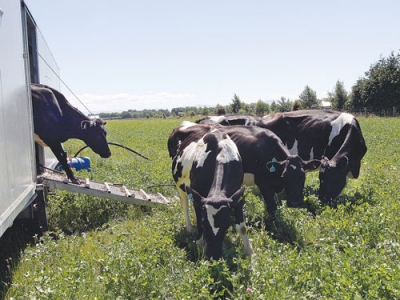 Cows leave the mobile shed after milking.
The wheels under Glen Herud's milking shed are the first indication he isn't your run-of-the-mill dairy farmer.
In fact, 'milking shed' is a bit of a misnomer as it's actually a mobile milk factory.
At about 15m long x just over 2m wide this innovative milk factory has a towbar at the front, is road legal and can be moved anywhere by tractor.
The self-contained operation takes the milk straight from the cows into a pasteuriser and then into either bottles or 16L milk churns and it's on its way to customers an hour after milking.
However unlike most dairy farmers who know they will sell 100% of each day's milking, when Herud milks his cows he has no guarantee anyone will buy his milk.
Wanting a way into dairying that didn't incur huge debt, Herud looked for a way to get customers to pay significantly more for their milk. He developed his mobile milk factory also as a way to stay true to his organic principles.
His company, Nature Matters Milk, has developed a business model centred on the mobile milk factory, that lets small-scale dairy farmers sell direct to the public and commercial users in their local areas.
This thinking-outside-the-box earned Herud one of eight Sprout Agritech business accelerator grants in January.
He said you must think about your brand, and the brand must always come first. And it is in cafes that he has found a place where his brand can stand out.
Realising that some cafes in Christchurch and Rangiora areas are particular about their coffee and how they want it made, Herud began selling direct to them.
He considers his full cream milk healthier than trim milk because it doesn't go through standardising and homogenising as does normal milk, which Herud describes as deconstructing the milk and then putting it back together.
As these cafes shifted to Herud's daily milk delivery, unexpectedly it kicked off a massive debate on social media, and then mainstream media, about the use of trim milk in coffee. As Herud only at this stage supplies full cream milk to these cafes, he has become the unwitting centre of the debate.
He openly admits to being a crap farmer but a great marketer and it's in his marketing that his organic milk has stood out.
Reflecting on the issue Herud chuckled and said, "it's a fun debate to have because obviously we have sorted out world poverty and ISIS has been defeated". But more significantly Herud and the cafes have used it as a marketing opportunity.
The cafes love the taste of his milk, and since he uses only replaceable containers (churns or glass bottles) they love the lack of waste. The Lyttelton Coffee Co, for instance, no longer uses 12,000 plastic milk containers a year.
Even though the cafes are paying double for their milk, the price of the coffees has stayed the same.
The recent bobby calves debate was another easy marketing win for him, as he keeps the bobby calves and uses older cows as nursing cows.
Whereas a large-scale dairy farmer would view each millilitre of milk drunk by a bobby calf as lost income, Herud views each millilitre drunk as a marketing cost.
Selling his milk for $4/L and getting $32/kgMS he has found a model that lets his 20 cow herd be financially viable. Saying that dairying needs to attract young farmers into the industry without getting crushed under a mountain of debt he feels that his business model offers a credible alternative.
His online blog shows his methodology and how his business model works: he says a farmer with 40 cows can have two staff earning $50,000 each, the farmer can earning $75,000 and still retain at least $100,000 profit for the farm.
Herud predicts this model would be attractive to a cropping farmer, for instance, with a model working for up to 200 cows.
These farmers would operate under Nature Matters Milk's risk management programme with MPI, minimising costs.
Herud has found MPI great to deal with; whilst he feels they probably felt it was a hassle to deal with such a small operation they have been helpful.
He is on a six monthly audit schedule; such was the interest in his factory that MPI's Tony Rumney flew down to do his first audit.
Everything in the factory is logged and his programme has many checks and balances, for instance each teat is wiped and sanitised before milking. The result is his bacteria levels are massively lower than the industry average.
Herud will use the Sprout Agritech grant to refine the mobile milk factory template, refining the design of the factory so that it becomes virtually impossible for the operator to break the rules.
To describe the scheme as a franchise is doing it a disservice; it appears more of a collective partnership of likeminded farmers.
Next on the plan for Nature Matters Milk and Herud is expansion and more staff, then they will launch butter production, then a trim milk (to appease the trim latte supping café set) and a chocolate milk.
Power tool manufacturer Makita has released details of its new cordless GP001G 40vMax XGT grease gun, designed as a practical and precise solution for lubrication of the largest machinery.

Can-Am has introduced its 2027 range of side-by-side vehicles (SSV) and all-terrain vehicles (ATV), including the industry leading Defender, the Maverick R and the hugely capable Outlander ATV, incorporating a host of advancements designed to deliver an exceptional riding experience.
New Zealand wool is reaching new heights as air filtration companies move away from synthetic products to biodegradable alternatives.
Generative AI in the workplace, trials in the field, and industry-relevant research took centre stage at this year’s Grape Days events in Central Otago, Hawke’s Bay and Marlborough.
Virtual fencing company Halter is going global but for founder Craig Piggott, New Zealand farmers will always remain their main partners.


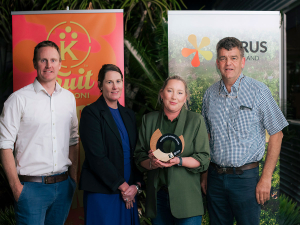
New Zealand's citrus growers were challenged to build their future on the value embedded in their fruit rather than the volume they produce, at Citrus New Zealand's annual gathering in Gisborne on 17 September.
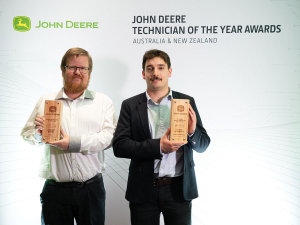
Leading John Deere technicians and apprentices from New Zealand and Australians were recognised at the recent sixth annual JD Technician of the Year Awards, held in Brisbane.
In Dacre, near Invercargill in New Zealand’s South Island, Bruce Dinnington is running a dairy operation unlike any other.
A free online platform aggregating governance vacancies across rural and regional New Zealand has been launched.
Environment Minister Nicola Grigg has announced details of a new rural plastics recycling scheme.
Agricultural drone operators say that a government decision to allow lower-risk drone work without certification won’t lower standards but drive innovation and efficiency.


OPINION: It seems Canterbury processor Synlait is still in the doldrums.
OPINION: Get offside with New Zealand First leader Winston Peters at your own peril.




