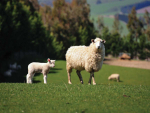
Early Weaning Lambs: What the Massey Trials Found
Farmers with high-quality feed available in late spring could consider weaning at least a proportion of their lamb crop early to benefit both lambs and ewes.




 increase font size
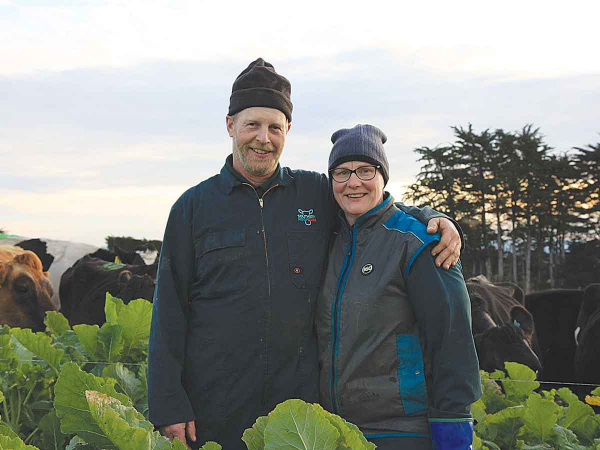 Sietze Feenstra and Simone Bouwmeester say following good wintering management practices brings a range of benefits.
Dairy farmers Sietze Feenstra and Simone Bouwmeester are enthusiastic about the future of wintering dairy cows on crop.
They put a lot of time and effort into ensuring good wintering practices on their farm and are enjoying the rewards.
“For us, we’re committed to doing the right thing for the environment and animal care,” Feenstra says. “We believe in doing things properly.”
The couple focus on feeding their cows well and with consistency to achieve excellent production, cow condition and animal welfare outcomes – both during the milking season and during the winter.
“Doing wintering well is great because you have more control,” Bouwmeester explains. “You get improvements in metabolics and condition, while transitioning cows from crops to grass is easier.”
She believes this sets them up for calving and the whole milking season.
The couple have been wintering their cows at home for six years. This season, they peak milked 240 cows and are on target to produce 127,000kgMS (530kgMS/cow).
In the 2020 winter, 160 cows will be wintered on farm with brassica and baleage, while another 90 cows will be wintered by a grazier because of crop rotation. All their cows will be wintered at home again next season.
The couple started out in dairy farming as 50:50 sharemilkers before buying a pregnancy scanning and calf disbudding company. They grew their business over 18 years, adding in a hoof trimming service and maintaining an AI run.
In 2013, a small dairy farm came up for sale, and Feenstra and Bouwmeester seized the opportunity to become farm owners.
In 2014 they bought an additional 50ha nearby. This extra area allowed them to have self-contained wintering.
A key to the couple’s success, with wintering, is ensuring they fully feed the cows.
“We make sure we have extra baleage and straw so they can have more if they need it, say if it snows.”
The couple have a rolling to hilly property, with three gullies with waterways at the bottom. They have fenced off critical source areas and have a buffer zone around the waterways of at least three metres, with permanent fencing on both sides.
“We’ve been able to put oats in straight after the cows come off the crop. That means the paddocks are looked after and not too muddy, and the soil quality is better.”
With their wintering, Feenstra and Bouwmeester stay in touch with the latest advice and information – including from DairyNZ – and continually review the costs and benefits of their system.
Several years ago, they introduced portable troughs and back fences. The combination redirects the cows’ energy use from walking around the paddock to putting condition on, thus improving feed efficiency.
In early 2019, Bouwmeester decided it was time to upskill further. She attended a DairyNZ Smart Wintering field day and then attended a Beef + Lamb NZ Land and Environment Plan (LEP) workshop later in the year. After this, she implemented the advice and tips she’d learned.
At this point, the couple fenced off at least 20m of crop to act as a buffer to the waterways. This is later fed at the end of winter, in dry conditions.
A written wintering plan with feeding and environmental policies and procedures documents is used and they also created an adverse weather plan, for managing through the tougher times.
Feenstra and Bouwmeester say their system is practical, efficient and cost-effective – while achieving excellent environmental and animal care results.
They encourage all farmers interested in getting the latest information and advice on wintering to check out the DairyNZ resources online at dairynz.co.nz/wintering
Farmers with high-quality feed available in late spring could consider weaning at least a proportion of their lamb crop early to benefit both lambs and ewes.
If growing more feed at home adds up to $428 profit per tonne of dry matter to your bottom line, wouldn’t it be good to have a ryegrass that gets you there quicker?
When buying supplementary feeds, farmers need to consider the entire package on offer – service, freight and all the components in a feed mix – not just focus on the price of the cheapest component – palm kernel meal, according to J. Swap Stockfoods sales manager Joe Hardman.
Two high producing Canterbury dairy farmers are moving to blended stockfeed supplements fed in-shed for a number of reasons, not the least of which is to boost protein levels, which they can’t achieve through pasture under the region’s nitrogen limit of 190kg/ha.
OPINION: Few things are more stressful for dairy farmers than running out of feed when cows need it most.


Federated Farmers has welcomed new rural policies released by ACT, saying they align closely with its own election priorities.

Rural Contractors NZ says proposed changes to land transport rules for agricultural vehicles are a welcome response by the Government to out of date regulations which have seen members hit with huge fines.
Alliance is calling for final applications for its 2027 Graduate Programme, with applications closing on Sunday 25 October.
Decades piloting planes has ensured vet and farmer David Hayes is focused on safety. So, after a serious accident while welding on farm, he is sharing his experience so others can learn from it.
Canterbury milk processor, Synlait Milk has confirmed Leon Fung as its chief executive officer.
OPINION: Making it easier to collect rainwater and use it to grow crops and livestock is a no brainer.


OPINION: It seems Canterbury processor Synlait is still in the doldrums.
OPINION: Get offside with New Zealand First leader Winston Peters at your own peril.




