
Resilient Global Dairy Industry Overcoming Volatility
Fonterra chief executive, Richard Allen says being resilient has helped the dairy industry overcome extreme volatility in recent years.




 increase font size
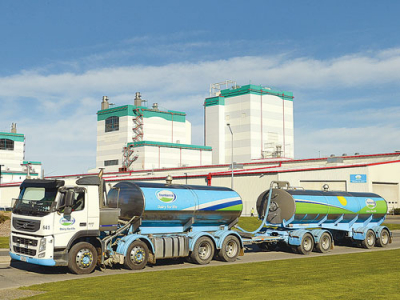 Fonterra has lowered its forecast milk collection for the 2017-18 season.
The co-op now expects to collect 1.540 billion kgMS from its suppliers; earlier it was expecting 1.575b kgMS.
In its October Global Dairy Update, Fonterra says milk collection will be only 1% higher than last season, which was hit by a poor spring.
The co-op says weather in August and September this year have impacted milk production across most of the country.
“The full season forecast is dependent on improved conditions through the rest of the season,” it says.
Rabobank dairy analyst Emma Higgins says the drop in NZ milk production has not rattled the markets; global milk prices have fallen in recent Global Dairy Trade (GDT) events.
She says whole milk powder prices have fallen in recent weeks despite Fonterra revising production forecasts.
“Milk collections are expected to increase just 1% compared to last season, down from 3% growth expectations set earlier this year,” says Higgins.
“Fonterra’s milk production forecast at 1% would see national production bounce 2 - 3% on last season. This is in line with Rabobank production growth expectations of 2.5 - 3.5% for the full season and anticipation for an extended, flatter peak of the season.”
Higgins says the global markets may react if NZ milk production forecasts fall further.
“We may need to see NZ milk production numbers drag lower before we see a price reaction emerge on the GDT platform,” she says.
Fonterra’s milk collection across NZ reached 171 million kgMS in September, 2% lower than September last season; for the four months to 30 September, milk collection was down 1% at 294m kgMS.
North Island milk collection in September reached 108m kgMS, 2% behind September last season; South Island milk was 63m kgMS, 2% behind last season.
Outside NZ, milk production data continues to show supply growth.
US milk production for the 12 months to July 2017 continues an upwards march of 2%, driven by higher yields and cheap feed. Irish milk production is leading the charge for growth out of Europe and although the supply engines of France and Germany are still behind last year’s production, Poland and Italy are also in positive territory for July 2017 year-on-year.
Australia milk collections were up 1.6% in the first two months of the new season.
Fonterra chief executive, Richard Allen says being resilient has helped the dairy industry overcome extreme volatility in recent years.

Northland farmer Greg Collins has taken over as chair of the Fonterra Co-operative Council.
Fonterra’s 2026 financial year was a year of delivery, with record volumes of milk collected, processed and shipped by the co-op.
Dairy farmers, still holding onto their Fonterra shares despite switching milk supply elsewhere or exiting the industry, now face a stricter share sell-down requirement.
Milk powder prices are continuing their merry run, firming up a potential $10/kgMS farmgate price this season.


OPINION: At first glance it appears that Father Christmas has delivered the rural sector good tidings, with most pundits predicting the return of the centre-right coalition.

For 15 years, Glenda Rees has travelled from Gore to Awarua, often several times a week, to keep watch over one of the country’s rarest birds.
With some farmers opposing a government-industry partnership set up to develop methane reducing products, one NZ company claims that it already has a product on the market.
During the nesting season, from September to December, industrious starlings can quickly build nests in the darker areas behind tractor and vehicle, usually close to hot engines, typically resulting in localised damage or in some cases complete write-offs.
The meat processing industry is much more collegial than it was in the past and is now more focused on common goals.
With the last couple of months having seen some potential tractor purchases put on hold with the impending election and continued input cost rises, year-to-date figures, ending September, has seen deliveries up around 5% over the same period in 2025, with a total of 2026 units.





OPINION: The same mainstream media muppets that brought you Jacindamania in 2017 have been flat out pimping for the Opportunities…
OPINION: Your old mate reckons the atrocious way farmers in the UK are treated by their lords and masters in…