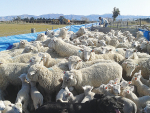
The importance of managing ewes in late pregnancy and early lactation
The ewe is under her greatest nutritional and metabolic stress in late pregnancy and in early lactation.




 increase font size

CONDITION SCORING tops a list of key actions to get the best from your flock, says a leading sheep consultant and vet.
“At the end of the day you will be sick of hearing me talk about condition scoring,” Trevor Cook told a Beef+Lamb NZ sheep production field day at Ahuroa, Northland. “It is the best tool you have to lift the performance of your flock.”
Recognising the barrage of flock management advice farmers often face, he ran through key actions for coming weeks at the field day which was held on Daniel and Nicola Berger’s farm.
The difference between farms making $48 per ewe per year and those making $189 is not because of where they live, or the type of farm, “it is just those guys that do a whole lot of stuff better – the basics better,” he stressed.
There’s a “clear set of things” that most affect the income, and it’s not a big list. In a breeding flock, number of lambs docked/tailed is key.
“I like to focus on getting as many lambs as possible at docking because that is how you make money.”
Lifting scanning percentage 11% can give a huge lift in profitability and eliminating low condition score ewes is often the key to that, he says.
“In my experience of North Island hill country flocks at any stage of the production cycle at least 15% of ewes are below [target] condition score.”
Eye-metering isn’t good enough, he adds.
“All of you will be missing at least 25% to 50% of low condition scores if you are using your eye….
“We have got some very good research data that shows us there’s a major production response from just focusing on condition score and lowering that below condition score to about 5% from about 15% (pre-mating)… I believe that should be the number one focus on every flock.”
The return on allocating feed to lift light ewes is massive, “way more than anything else you can do on the farm,” he stresses.
“The number of ewes below condition score 3 will put the ceiling on what your scanning percentage is.”
While no-one likes conditions scoring and it is time consuming, it can often be done with other operations, such as at scanning where the person pushing ewes into the scanning crate can be trained to condition score them in doing so, he suggests.
A key date is 35 days before start of lambing. From that date the aim is to ensure ewes carrying multiple lambs do not lose any more condition. If they don’t get enough feed, not only do ewes go “sleepy” but lambs will be born dopey and the single biggest influence on survival from birth to docking is how quickly the lambs stand up.
“A lamb which is born and suckles within 20 minutes has a 90% chance of being alive 90 days later.”
While that’s a concern for the coming winter, if there’s still an opportunity to lift light ewes to condition score 3 or better for mating, the return on that is about 45%, he says.
In the run-up to mating, it’s important to remember the rams. “We know that whole production cycle of sperm starts eight weeks before that sperm is mature. Anything we do to put stress on that ram in that eight week window will put a block in the production cycle.”
That eight weeks before mating are so important they should be highlighted on the calendar - “that calendaring is essential” – and be on the alert for any health issues, including pasture endophytes.
For ewes, assuming they’re in adequate condition, the “20 golden days” are the 10 days before start of mating and first 10 days of mating itself.
The ewe is under her greatest nutritional and metabolic stress in late pregnancy and in early lactation.
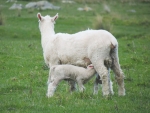
Roger Tweeds runs 2300 Romney ewes and 200 hoggets on his 300ha farm near Lawrence, Central Otago.
Whether you have a ewe with a bearing, a ewe you want to take a lamb to, or a ram you want to use as a teaser – it can be harnessed, says Rurtec.
ANDREW AND Gretchen Freeman aim to get every ewe to rear two lambs, every year, regardless of whether they drop one, two or three. It’s their Ewe 2 strategy, and it’s working.
Entries are now open for the New Zealand Ewe Hogget Competition which is held in conjunction with the West Otago Southland Ewe Hogget Competition.



New Zealand's 2026-27 freshwater fishing season has opened, with anglers encouraged to head to rivers and lakes over the coming days as conditions look favourable across much of the country.
Central Otago District Council (CODC) has voted against a plan to spread treated sewage sludge from Cromwell and Alexandra on farmland near Lauder, a decision Federated Farmers says reflects strong opposition from rural residents.
Pāmu has released its FY26 Integrated Annual Report, reporting a Net Operating Profit of $113 million, more than double the $49 million recorded in FY25.
Meat Industry Association data, released alongside the Red Meat Sector conference in Wellington, shows export value climbing across the US, China, UK and Canada.
Applications are set to open for the 2027 Zanda McDonald Award, a trans-Tasman award recognised for identifying and fast-tracking talented young leaders in agriculture and agribusiness.
The Royal New Zealand College of General Practitioners (the College) and Hauora Taiwhenua Rural Health Network are calling for investment in a proposed new training pathway for rural GPs, warning that many rural practices are struggling to recruit while a large share of the existing workforce nears retirement.



OPINION: The same mainstream media muppets that brought you Jacindamania in 2017 have been flat out pimping for the Opportunities…
OPINION: Your old mate reckons the atrocious way farmers in the UK are treated by their lords and masters in…




