
Record $10/kgMS milk price forecast means extra cash for Fonterra farmers
A record $10/kgMS opening forecast milk price for the new season means more money into Fonterra farmers pockets early, says Federated Farmers dairy chair Richard McIntyre.




 increase font size
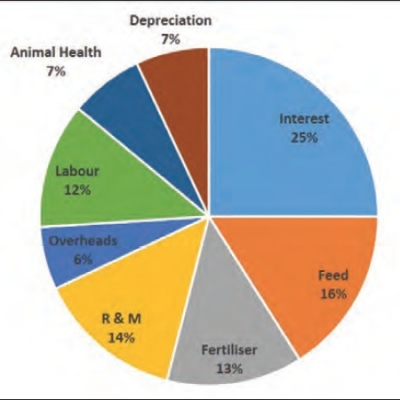 Total production cost of an average NZ dairy farmer
A BIG drop in the milksolids price has left many farmers wondering how they can make a profit – or at least minimise their loss – in what promises to be a financially challenging season.
Profit is the difference between income and costs. There are essentially three ways to increase profit: increase income, decrease costs or do a combination of both.
Cutting costs which do not affect production (e.g. deferring the purchase of a new ute) will automatically improve profitability, however the reality is that many farm costs (e.g. depreciation and labour) are semi-fixed. Reducing inputs such as feed, fertiliser or animal health is likely to have some impact on production, either now or in future seasons. This is where budget slashing gets a whole lot trickier.
In a paper titled ‘Smarter spending for a low payout’ presented at a recent Southland Demo Farm field day, Howard de Klerk (Dairy Nutrition and Management Solutions) shows that the biggest cost to the average NZ farmer is interest (Table 1).
De Klerk points out that while it is not included in farm working expenses, and therefore the net profit per hectare, interest has a major impact on the amount of cash the farm generates. Changing production per cow will not alter interest (assuming no extra shares are required or sold), but as production rises, interest per kgMS drops. Diluting interest costs by keeping production up is important, especially for farms with higher debt loadings.
The key, according to De Klerk, is to find the level of production where operating costs are controlled, but the farm is producing enough milk to dilute interest and other semi-fixed costs. At this ‘sweet spot’ profit is maximised; production below this level is not optimum and production above this level is simply buying production.
So what are the keys to farming profitably in a low payout year?
Good farm management practices should apply whether the payout is low or at record levels. The key difference is that in a high payout year you can make more mistakes and still be profitable. Three things to consider are:
Reduce costs carefully
Before cutting any input ask yourself, what will be the impact on production, and will the saving outweigh any potential loss in income? Reducing feed input usually reduces milk output. Be realistic about how much supplementary feed you need. Don’t assume you can make it through with a lot less than previous seasons unless you can see realistic opportunities to increase pasture and/or supplement utilisation, or are happy to accept a drop in production.
Make sure your comparative stocking rate (CSR) is in the correct range.
DairyNZ recommends a CSR around 80 to maximise profit. This means that for every tonne of feed offered there should be about 80kg of cow liveweight to eat it. See http://www.dairynz.co.nz/feed/feed-management-tools/comparative-stocking-rate/ to calculate your CSR.
Purchase supplements wisely and use them strategically.
The main aim of feeding supplements is to fill feed gaps, and therefore produce more milk. It will always be uneconomic to feed supplements and waste pasture, or to waste supplements. Think about what you are trying to achieve with your feed, and compare bought-in supplements on a c/MJME basis. Look for opportunities to reduce your supplementary feed spend by switching to a higher proportion of lower cost, home-grown supplements such as maize silage.
As de Klerk points out, profit will already be down this season due to the lower milk price.
Reducing production could reduce profit even further so think carefully before you make any decision to cut costs which will drastically affect your production.
For a full copy of ‘Smarter spending for a low payout’ visit http://www.siddc.org.nz/assets/Stlh-Demo-Farm-Focus-Days/Handout-Focus-Day-Oct14-2.pdf.
• Ian Williams is a Pioneer forage specialist. Contact him at This email address is being protected from spambots. You need JavaScript enabled to view it.
A record $10/kgMS opening forecast milk price for the new season means more money into Fonterra farmers pockets early, says Federated Farmers dairy chair Richard McIntyre.

OPINION: It's that time of the year again when milk processors announce their annual results and final milk payout for the previous season.
A record milk payout for this season remains on the cards - but breaking the $10/kgMS ceiling will be a stretch.
New Zealand's fledgling dairy goat industry is in turmoil.
Fonterra farmers are in line to be paid a milk price over $9/kgMS for the first time ever.


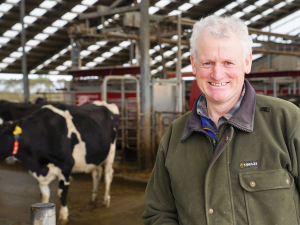
In Dacre, near Invercargill in New Zealand’s South Island, Bruce Dinnington is running a dairy operation unlike any other.

A free online platform aggregating governance vacancies across rural and regional New Zealand has been launched.
Environment Minister Nicola Grigg has announced details of a new rural plastics recycling scheme.
Agricultural drone operators say that a government decision to allow lower-risk drone work without certification won’t lower standards but drive innovation and efficiency.
OPINION: Warning bells are ringing in the arable sector.
Farmgate lamb prices are down by 8%, beef cattle by 4.5% and farm expenditure up by 4.2%.




OPINION: It seems Canterbury processor Synlait is still in the doldrums.
OPINION: Get offside with New Zealand First leader Winston Peters at your own peril.




